No state asks more of a gun buyer, or of a gun store, than California. Buyers pass a written safety test, clear a state background check, and wait 10 full days before they can take a firearm home. Then they come back to your counter for a background check every time they buy ammunition. Meanwhile, your inventory is limited by a handgun roster, an assault weapons ban, a 10-round magazine limit, and an 11% excise tax.
It would be easy to see all of that as a list of reasons people buy less. Look closer, though, and California actually gives dealers something most states never do: repeated, guaranteed contact with every buyer. The safety test usually happens in your store. The background check happens at your counter. The 10-day wait guarantees a return visit, and the ammunition rules guarantee many more after that.
Few retailers in any industry get that many built-in touchpoints with a customer. The question is whether you use them.
Shops that treat each step as a chore lose buyers to shops that make each step feel easy. Shops that treat each step as a chance to help, educate, and offer something useful build customers for life.
This guide walks through California’s current rules and shows retailers and ranges how to turn each one into a reason to buy from them.
What California Buyers Face Today
California’s rules are detailed and change often, so every store should keep the California DOJ Bureau of Firearms bookmarked. Here is the current shape of the buying process.
Before the Purchase
Most buyers need a Firearm Safety Certificate (FSC) before they can purchase any firearm. The FSC requires passing a short written test administered by a DOJ-certified instructor, and many dealers offer the test right at the counter. Once earned, the certificate stays valid for five years.
Buyers generally must be 21 or older, with limited exceptions, and must present a valid California ID along with proof of residency.
At the Counter
The dealer submits the purchase through the state’s Dealer Record of Sale (DROS) system, which triggers a state background check. Then the 10-day waiting period begins. That wait applies to every firearm purchase, and the state can delay the transfer further if it cannot confirm the buyer’s eligibility within that window. Handgun buyers also complete a safe handling demonstration when they take delivery.
What You Can Sell
California’s inventory rules narrow the shelves considerably:
- Handguns must appear on the state’s roster of certified handguns to be sold new by a dealer.
- AR-style rifles can be sold only in California-compliant configurations, such as featureless or fixed-magazine builds.
- Magazines are limited to 10 rounds. The Ninth Circuit upheld that limit in 2025.
- An 11% state excise tax applies to firearms, parts, and ammunition, on top of sales tax.
After the Purchase
California requires a background check for every ammunition purchase, and buyers generally must buy ammo through a licensed in-state vendor. A Ninth Circuit panel ruled the ammunition check unconstitutional in 2025, but the full court agreed to rehear the case, and the requirement remains in effect while that review continues.
That last rule matters more than most dealers realize. Every California gun owner must return to a licensed counter to buy ammunition. That makes your store a recurring destination, not a one-time stop, and it is the foundation for everything else in this playbook.
Step One: Make the FSC a Sales Moment, Not a Speed Bump
In most states, the first government requirement happens somewhere else: a sheriff’s office, a state website, a separate training facility. California is different. Because many dealers administer the FSC test themselves, the first step of the process often happens right at your counter. That is a huge advantage, provided you treat it like one.
Remove the Anxiety
First-time buyers often feel nervous about the FSC. They worry about failing a test in front of strangers, and some walk out rather than risk it. You can remove that fear with a few simple moves:
- Put a sign near the counter that explains the FSC in plain language: what it is, how long it takes, and that it is a short, straightforward test.
- Point buyers to the free study guide the state publishes, and keep printed copies available.
- Offer a quiet spot to take the test so nobody feels watched.
- Train your staff to describe the test as routine, because for a prepared buyer, it is.
Use the Waiting Time Well
The FSC test and DROS paperwork take time. Instead of letting a buyer sit idle, use those minutes to understand what they actually need. Are they buying for home defense, for sport, for hunting? Do they have a safe at home? Have they ever taken a class? Those answers tell you exactly which package to recommend later.
This is also the right moment to collect the buyer’s mobile number along with clear, written consent to receive updates. You are about to begin a 10-day wait, so you will want a way to stay in touch.
Give Ranges a Seat at the Table
Ranges can play two roles in California. First, many ranges with certified instructors can administer the FSC themselves, which turns a first-time shooter lesson into a natural on-ramp to a purchase. Second, ranges can offer introductory classes for new owners, which California buyers often want after passing a test that covers safety in theory but not in practice.
Put every class on an online calendar with self-booking. RangeWorks is built for the range industry and offers the most depth for class scheduling, while Taplo handles class and event booking with a lighter setup.
Retail stores without a range should form a partnership with one nearby. Refer new owners to the range for a first lesson, and ask the range to refer their students to you for purchases. Both businesses win when the buyer gets a smooth, guided experience.
Step Two: Build Packages Around Compliant Inventory
A California buyer has studied for a test, passed it, paid an excise tax, and committed to a 10-day wait. That buyer is invested, and an invested buyer is the best possible candidate for a complete package.
Some dealers bristle at anything resembling a discount. Treat this as something else: a reward for completing the most demanding buying process in the country. A well-built package makes the buyer feel recognized, and it captures accessory spending that would otherwise drift to other stores over the following months.
Sell Compliance as a Feature
California buyers worry about getting something wrong. They wonder whether a magazine is legal, whether a rifle configuration is compliant, or whether an accessory will create a problem. Your expertise solves that worry. Position every package as “California-ready”: every item checked against state rules, assembled by people who know them.
Three tiers per category keep the choice simple:
| Category | Starter | Ready | Complete |
|---|---|---|---|
| Rostered handgun | Pistol, 10-round magazines, cleaning kit, lock | Starter plus holster and lock box | Ready plus light, quick-access safe, and an intro class |
| Compliant rifle | Featureless or fixed-magazine rifle, cleaning kit, ammo | Starter plus optic and sling | Ready plus hard case and a range session |
| Home defense shotgun | Shotgun, cleaning kit, ammo | Starter plus light and sling | Ready plus safe and a defensive shotgun course |
Include Ammunition Deliberately
California’s ammunition rules make ammo one of your strongest bundle items. Buyers cannot simply order a case online and have it shipped home. Including a starter supply in the package removes a hassle on day one, and it establishes your store as the place they return to for every refill. Just make sure your staff runs any ammunition eligibility check the state requires for that portion of the sale.
Watch the Margin and the Tax
Because the 11% excise tax raises the cost of firearms and ammunition, lean on accessories to build perceived value: holsters, cases, cleaning kits, safes, lights, and optics. Those items carry healthier margins, and they make the package feel generous without squeezing your profit.
Ranges can do even better. Add a trial membership, free lane time, or a discount on an advanced class. Those extras cost little, yet they bring the buyer back to you again and again.
Step Three: Fill Ten Days, Then Build the Ammo Habit
Ten days is one of the longest waiting periods in the country. That is plenty of time for doubt, comparison shopping, and fading excitement. It is also plenty of time for a thoughtful dealer to build a relationship.
Plan the Ten-Day Sequence
Set up automated messages that carry the buyer from purchase to pickup:
- Day 1: confirmation of the purchase and the exact date pickup opens.
- Day 3: a short safe-storage tip, plus a reminder that lock boxes and safes are available.
- Day 6: an invitation to book a first range session or intro class.
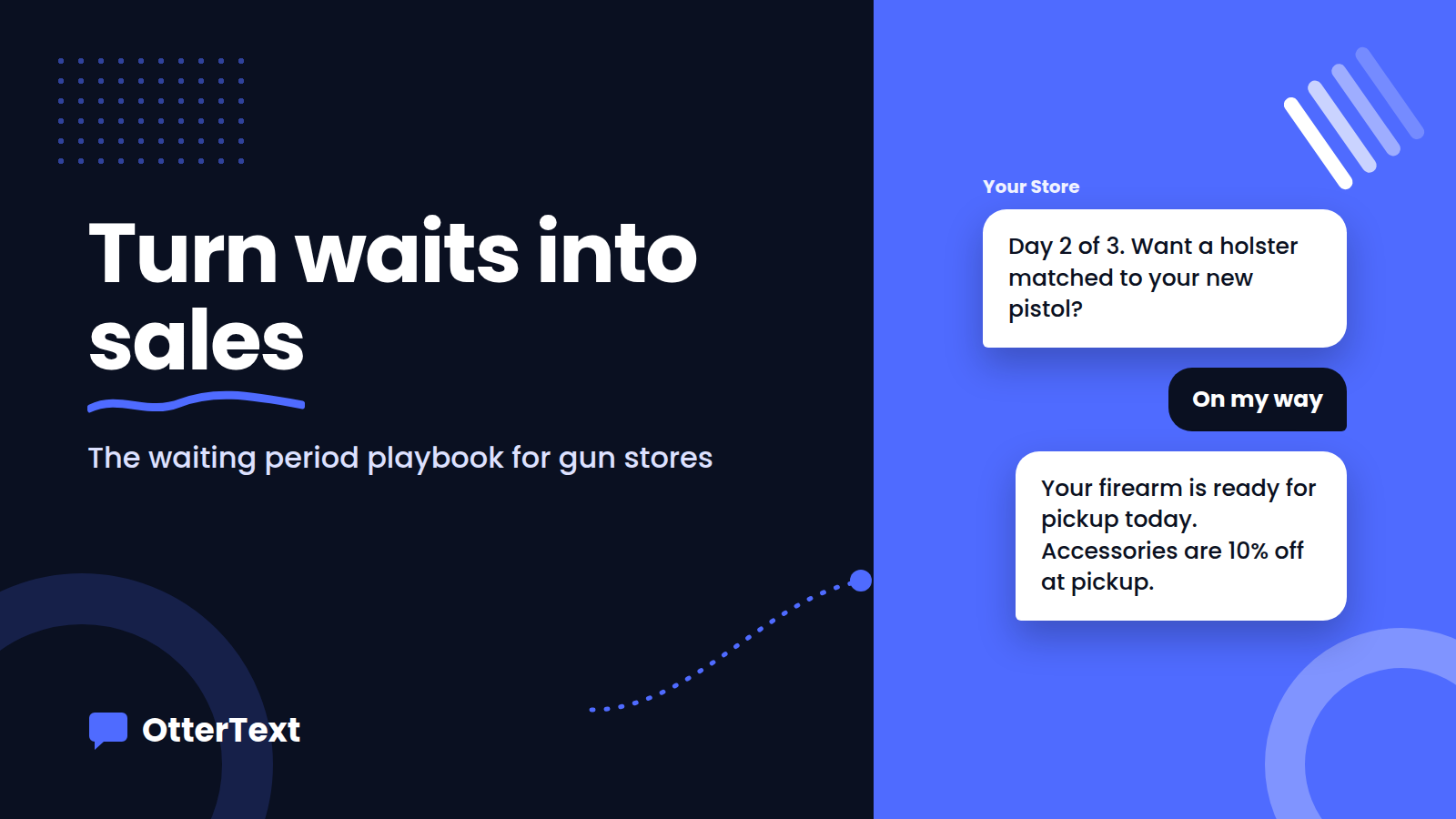
- Day 9: “Tomorrow is pickup day. Want us to have a holster or light ready?”
- Day 10: “Your firearm is ready for pickup today! Any accessories you add at pickup are 10% off.”
That final message brings the buyer in promptly and creates one last upsell when they feel most excited.
Turn Ammunition into a Habit
After pickup, the relationship does not have to end. Every California gun owner must return to a licensed counter for ammunition, so give them a reason to choose yours. Send occasional, opted-in messages when popular calibers come back in stock. Promote range days that pair lane time with an ammo purchase. Remind buyers of any loyalty rewards you offer. A store that makes the ammo trip easy becomes the default store.
Automate It
OtterText lets firearms retailers and ranges build these sequences once and run them for every buyer automatically. Messages can go out by SMS, email, or Telegram, and Telegram runs outside the carrier networks that filter firearm content.
Keep It Compliant
Carriers treat firearm-related texts as sensitive content and filter them aggressively, and the Telephone Consumer Protection Act (TCPA) requires clear consent for marketing texts. Build good habits from day one:
- Collect written opt-in with a clear checkbox; a phone number on a DROS form is not consent.
- Register your messaging through 10DLC, and expect extra scrutiny as a firearms business.
- Separate transactional and promotional messages, since each follows different rules.
- Write professionally about orders, pickups, classes, and stock updates.
- Include opt-out instructions in every marketing message.
- Offer Telegram as a second channel so critical updates reach buyers when carrier filters tighten.
Many mainstream texting tools refuse firearms businesses outright. OtterText was built for regulated industries, including firearms retailers and ranges, so compliance is part of the setup.
This article is general information, not legal advice. California firearm law changes frequently and several provisions are in active litigation, so consult a licensed attorney and confirm current requirements with the California DOJ Bureau of Firearms.
Cases Worth Watching
Several court cases could reshape the California market over the next year. The full Ninth Circuit is reconsidering the ammunition background check requirement. In addition, the U.S. Supreme Court agreed in June 2026 to decide whether bans on AR-15 platform rifles violate the Second Amendment, with a ruling expected by the end of June 2027. That decision could affect California’s assault weapons law along with similar laws in other states.
No one can predict how those cases will end. Still, smart dealers prepare for change instead of reacting to it. Start an opt-in interest list for customers who ask about firearms or accessories they cannot buy today. Keep it warm with occasional, factual updates. If the law changes, you will have an audience ready on day one. If it does not, you will still have a list of engaged customers to market everything else to.
The California Playbook
California’s rules are demanding, and they are not getting simpler. Even so, demand for firearms across the state remains strong. Buyers simply need a store that guides them through the process instead of making them feel like a burden.
To recap:
- Make the FSC a sales moment by removing anxiety, learning what the buyer needs, and capturing their consent to stay in touch.
- Partner with ranges for testing, first lessons, and referrals in both directions.
- Sell California-ready packages built around compliant inventory, with ammunition included.
- Fill all ten days with helpful, automated messages that end in a pickup-day upsell.
- Build the ammo habit so every refill brings the buyer back to your counter.
Every competitor who treats California’s rules as an excuse is handing you an opportunity. The store that makes this process easy will earn more than one sale. It will earn every ammunition trip, every accessory, and every future firearm.
Ready to automate every step from FSC to pickup day and beyond? See how OtterText helps firearms retailers and ranges keep California buyers coming back.