Colorado did not ban the AR-15. Instead, it turned buying one into a five-step project. As of August 1, 2026, anyone who wants a new semiautomatic rifle with a detachable magazine has to clear the sheriff, earn an eligibility card, pass a training course, buy from a dealer, and then wait three more days before taking the gun home.
Most of the industry reacted to SB25-003 the same way. Dealers vented, ranges worried, and plenty of shop owners assumed their rifle sales would simply dry up. Some of that worry is fair. Every extra step in a buying process is a place where a customer can quit.
Here is the part that gets missed, though. The law did not change what buyers want. It changed how hard it is for them to get it. That shift creates a gap, and the businesses that close it will take the sales their competitors lose.
Think about it from the buyer’s side. A first-time buyer walks into your store, learns about the new requirements, and hears a vague explanation along the lines of “you need to go see the sheriff and take some class.” That person leaves confused, and a confused buyer rarely comes back. Now picture a different store. The counter has a QR code that starts the sheriff application. The staff can book the training on the spot. A text message keeps the buyer updated at every step, and a reward is waiting when they finish. Which store gets the sale?
The rule is simple. If you make this process feel difficult, you will lose firearm sales. If you make it feel easy, you will sell more firearms than you did before.
This guide walks through each step of the new Colorado process and shows retailers and ranges exactly how to remove friction, reward the buyer, and automate the follow-through.
What Colorado’s New Process Actually Requires
Senate Bill 25-003 covers what the state calls “specified semiautomatic firearms.” In practice, that includes AR-15 and AK-style rifles, many semiautomatic shotguns with detachable magazines, and gas-operated pistols that take detachable magazines. Recoil-operated handguns, which make up most of the pistol market, fall outside the new purchase requirements.
For a covered firearm, the buyer now moves through five stages:
- Sheriff application. The buyer applies through their county sheriff’s office, which runs a background check, verifies ID, and takes fingerprints.
- Eligibility card. If approved, the sheriff issues a Firearms Safety Course Eligibility Card.
- Training. The buyer completes a state-approved course with a verified instructor and passes a written test with a score of 90% or higher. The course runs either 4 hours or 12 hours, depending on whether the buyer already holds verified hunter education credentials.
- Purchase. With the card and training record in hand, the buyer can purchase from a licensed dealer.
- Waiting period. Colorado’s existing three-day waiting period still applies, so the buyer cannot take the firearm home on the day of purchase.
Once a buyer completes the process, their eligibility lasts five years. That detail matters a great deal for your business, and we will come back to it.
A few other Colorado rules still sit on top of all this. Buyers must be 21 or older. Magazines remain capped at 15 rounds. Rapid-fire devices like bump stocks and binary triggers can no longer be bought or sold. Existing owners are not affected, since the law targets new purchases and transfers rather than firearms people already own.
The official guidance lives on the Colorado Parks and Wildlife specified semiautomatic firearms page, which explains the application and training requirements in detail. Bookmark it, train your staff on it, and point customers to it.
Look at that list again, this time through the customer’s eyes. Each step involves a different office, a different schedule, and a different set of instructions. Every handoff is a chance for the buyer to give up. Your job is to own those handoffs.
Step One: Make the Sheriff Visit Painless
The sheriff application is the first wall a buyer hits, and it is the one most likely to stop them cold. Most people have never contacted their sheriff’s office for anything. They do not know whether to call, walk in, or apply online, and they certainly do not know which office handles their address.
You can solve that problem in about an afternoon.
Put a QR code at the counter. Print a simple sign that reads “Don’t have your permit card yet? Scan here to get started.” The code should take buyers straight to the application page for your county sheriff. Place the sign next to the rifle rack, at the register, and on the front door. Then add the same code to your receipts, your website, and your social posts.
Build a county lookup page. If you want to go further, put a single page on your website where a buyer enters their address and instantly sees their local sheriff’s office, its phone number, and the link to apply. This matters most for stores that draw from several counties. A buyer who drove forty minutes to your shop should not have to figure out on their own which sheriff covers their home.
Train your staff on a short script. Every employee should be able to explain the five steps in under a minute, without sighing or complaining about the law. Customers take their emotional cues from your team. If your staff treats the process as an insult, the buyer will see it as an obstacle. If your staff treats it as a checklist, the buyer will see it as manageable.
Capture the lead before they leave. This is the most important move in the entire process. A buyer who is still waiting on a sheriff appointment is not ready to buy today, but they are ready to buy soon. Get their name and mobile number, along with their consent to receive text updates, before they walk out the door. Otherwise, you are trusting them to remember your store weeks from now, after they have passed a class that a competitor may have booked for them.
That last point leads directly into the next step, because the training course is where you either keep the customer or hand them to someone else.
Step Two: Own the Training Handoff
Training is where Colorado’s law quietly hands ranges a major advantage. A range that already teaches classes can become the natural first stop for every new buyer in its area. Retailers without a range, on the other hand, risk sending customers somewhere else for the most memorable part of the process.
Both sides can win here, but only if they work together.
If You Are a Retail Store
Partner with one or two local ranges or verified private instructors. Do it this month, before your competitors lock up the best relationships. Then, when a buyer asks where to take the class, your staff hands them a specific answer instead of a shrug.
The range will love the steady stream of students. In return, it is completely reasonable to ask for a referral arrangement, since you are sending them paying customers. Even more valuable, ask the range to send graduates back to you to make their purchase. A buyer who hears “go see our friends at the shop down the road” from their instructor arrives already trusting you.
Make the referral easy, too. A card with the range’s booking link, a QR code, or a direct text with the class schedule all work far better than verbal directions.
If You Are a Range
Your goal is to make booking a class as easy as booking a haircut. That means a live schedule online, self-service booking, and instant confirmation. If a buyer has to call during business hours and leave a voicemail, many of them never will.
Software handles most of this for you. RangeWorks is built specifically for the range industry and offers the most depth for managing class schedules. For a simpler setup, Taplo lets you list classes and events and accept bookings without the complexity of a full range management system.
Whichever tool you choose, publish every SB25-003 course on it, share the booking link with every retail partner, and keep enough sessions on the calendar to meet demand. A full class with a waitlist is a good problem. A buyer who cannot find any open class for six weeks is a lost sale for everyone in the chain.
One more thing: remember that eligibility lasts five years. A student you train today is a customer for your memberships, your advanced courses, and your retail counter for years to come.
Step Three: Reward the Buyer for Finishing
Many people in this industry bristle at the word “discount.” They worry it cheapens the brand, trains customers to wait for deals, and eats into already thin margins. Those concerns are valid in normal times. This is not a normal situation, however.
Consider what your buyer just went through. They applied with the sheriff, got fingerprinted, waited for approval, paid for a course, gave up a day or a weekend to sit through it, and passed a written test. They invested real time and real money before they were even allowed to shop.
So do not think of it as a discount. Think of it as a reward for finishing. A congratulations package recognizes the effort the buyer made, and it gives them a reason to spend that hard-earned eligibility with you instead of with the store across town.
Build Three Tiers
Offer three packages for each major category so buyers can choose their level. For example, an AR-15 lineup might look like this:
| Package | What It Includes | Who It Is For |
|---|---|---|
| Starter | Rifle, cleaning kit, compliant magazines, ammo bundle | Budget-focused first-time buyers |
| Ready | Starter items plus an optic and a sling | Buyers who want to hit the range right away |
| Complete | Ready items plus a quality optic upgrade, hard case, and extra training | Buyers who want everything set up from day one |
Run the same structure for handguns, with packages built around specific models you stock in depth. Covered gas-operated pistols require the full process, but you can apply the same idea to any first-time buyer.
Load the Packages with High-Margin Items
The smartest packages lean on accessories where your margin is strong: cleaning kits, slings, holsters, cases, safes, and ammo bundles. The perceived value climbs quickly while your actual cost stays controlled.
Ranges have an even better lever. Add a trial membership, a free range session, or a follow-on course to the package. Those add-ons cost you very little at the margin, yet they feel substantial to the buyer and they bring that person back through your doors.
Aim for this feeling: the buyer spent money getting certified, and you handed them back that much value or more. That is how you make them proud, excited, and loyal before they have fired a single round.
Step Four: Automate the Wait and the Pickup
The three-day waiting period feels like dead time, yet it is one of the best selling windows you have. The buyer has committed, paid, and chosen a package. Now they are counting down the days. Silence during that stretch wastes their excitement, while a well-timed message builds on it.
This is where text messaging earns its keep. Customers read texts within minutes, and a short, friendly message keeps your store front of mind through every stage of the process.
Map a Text to Every Stage
Consider setting up automated messages at each point where a buyer might otherwise drift away:
- After the first visit: a link to the sheriff application and a reminder that your team can answer questions anytime.
- After card approval: congratulations, plus the booking link for your partner range or your own classes.
- After passing the course: a reminder that their congratulations package is waiting, with all three tiers listed.
- At purchase: confirmation of their order and the date their waiting period ends.
- On pickup day: the message that matters most.
Make Pickup Day an Event
When the waiting period ends, send a message along these lines:
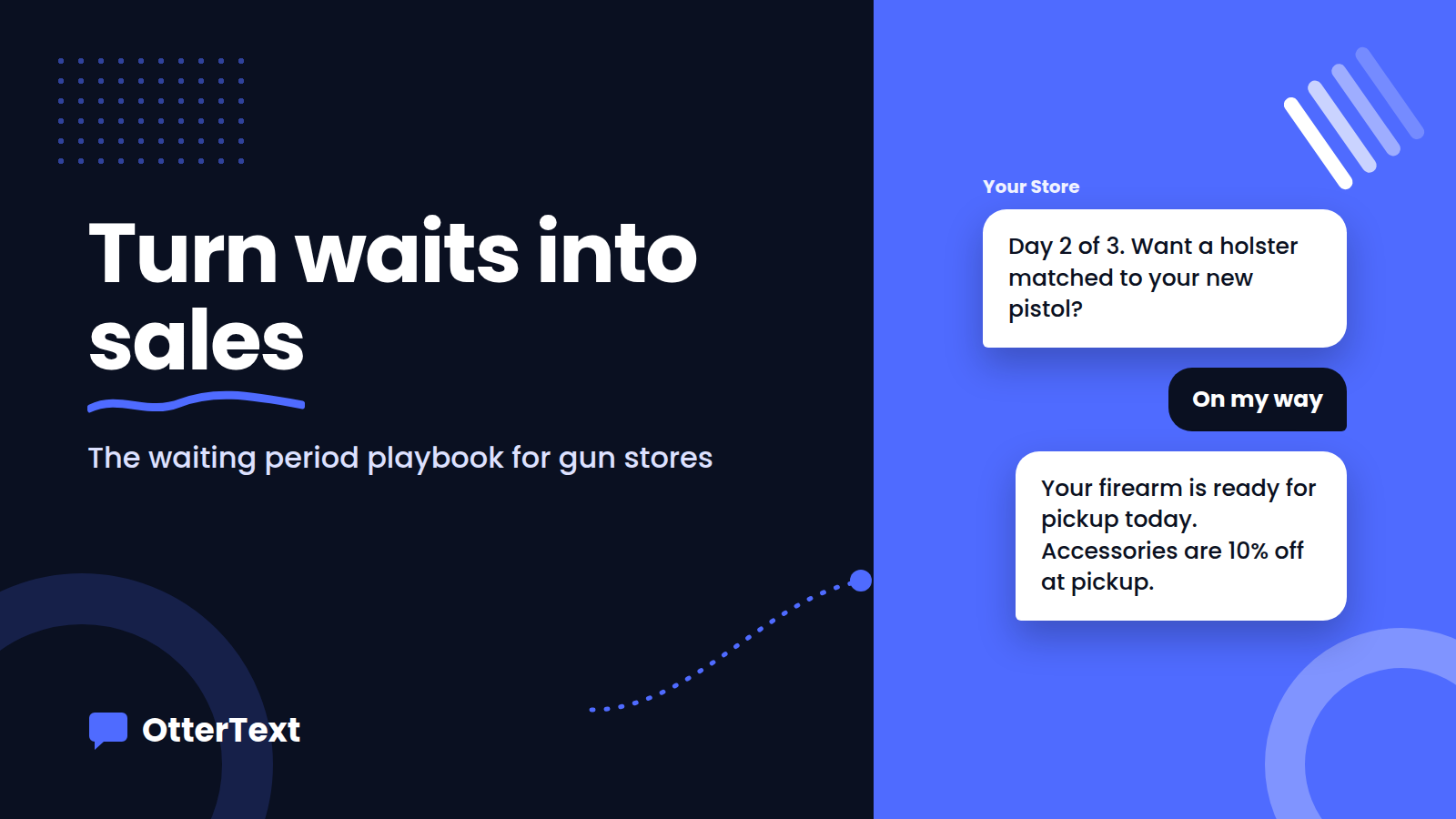
“Great news, your rifle is ready for pickup today! Any accessories you add when you come in are 10% off. See you soon.”
That single text does two jobs. First, it gets the buyer in the door quickly, which frees up your inventory and closes the transaction. Second, it creates one more upsell at the exact moment the buyer feels the most excited. People picking up a new firearm almost always want a little more gear to go with it, so give them a reason to buy it from you that day.
Set It Up Once
None of this should depend on an employee remembering to send a message. Platforms like OtterText let firearms retailers and ranges build these sequences once and run them automatically for every buyer. Messages can go out by SMS, email, or Telegram, and Telegram runs outside the carrier networks that filter firearm content. Your staff focuses on the counter while the follow-up happens in the background.
Ranges can tie the same automation to class bookings, so every confirmed student gets reminders before the course and a follow-up afterward pointing them to the next step.
Keep Your Texts Compliant and Delivered
There is a catch with firearms texting that many retailers learn the hard way. Wireless carriers treat firearm-related messages as sensitive content, and they filter it aggressively. A pickup reminder that reads perfectly to you can be silently blocked before it ever reaches the customer’s phone.
On top of carrier filtering, federal rules under the Telephone Consumer Protection Act (TCPA) require clear consent before you send marketing texts. Fines for violations add up fast, and a single complaint can put your entire messaging program at risk.
Fortunately, a few habits keep you safe:
- Get written opt-in at the counter. Use a clear checkbox or signed form that explains what kinds of messages the buyer will receive. Never assume consent because someone gave you their phone number.
- Register your messaging properly. Business texting from standard local numbers requires 10DLC registration, and firearms businesses face extra scrutiny during that review. Work with a provider that understands the approval process for your industry.
- Separate transactional and promotional messages. A message confirming that a firearm is ready for pickup is different from a sale announcement. Keep them distinct so each type follows the right rules.
- Write carefully. Clear, professional language about orders, appointments, and store events tends to deliver more reliably than aggressive promotional copy.
- Always include opt-out instructions. Every marketing message should tell the recipient how to stop receiving texts.
- Offer Telegram as a second channel. Telegram messages travel over the internet rather than carrier networks, so firearm content is not subject to carrier filtering. Invite buyers to opt in on Telegram as well as SMS.
This is also why your choice of platform matters. Many mainstream texting tools either prohibit firearms businesses outright or shut accounts down without warning. OtterText was built for regulated industries, including firearms retail and ranges, so the compliance setup is part of the onboarding rather than an afterthought.
This article is for general information only and is not legal advice. Firearm and messaging regulations change often, so consult a licensed attorney about your specific situation, and confirm current requirements with your county sheriff and Colorado Parks and Wildlife.
The Stores That Make It Easy Will Win
SB25-003 raised the bar for every buyer in Colorado. Still, it did not touch demand. People in your area want to buy rifles just as much as they did last year. What changed is that they now need someone to guide them through the process.
That someone should be you.
To recap the playbook:
- Make the sheriff step simple with QR codes, a county lookup page, and a confident staff script.
- Own the training handoff through range partnerships, referral arrangements, and online booking.
- Reward the finish with three-tier congratulations packages loaded with high-margin items.
- Automate the follow-through with compliant text messages at every stage, especially on pickup day.
Every competitor who complains about the law and leaves customers to figure it out alone is handing you their sales. Meanwhile, every buyer you guide through the process becomes a customer with five years of eligibility, a reason to trust you, and a habit of coming back.
Ready to put the follow-up on autopilot? See how OtterText helps firearms retailers and ranges automate every step from first visit to pickup day, with compliance built in from the start.