A payment is not the end of a customer interaction. It is one of the clearest signals a business will ever receive: what someone bought, where they bought it, how much they spent, and whether they are likely to return. Integrated payments marketing automation puts that signal to work while the intent is still fresh.
For a retailer, range, restaurant group, service business, or multi-location brand, that changes the math. Instead of exporting transaction data, waiting for a report, and manually building a campaign days later, the payment event can trigger the next relevant message, loyalty action, review request, or collection reminder automatically.
Why disconnected payments leave revenue behind
Most businesses already have payment data. The problem is that it sits in the wrong place. The point-of-sale system knows a customer made a purchase, the marketing platform knows who is subscribed, and the loyalty program may know their rewards balance. When those systems do not communicate, teams are forced to guess at timing and relevance.
That guesswork shows up in familiar ways: broad promotions sent to customers who just purchased, review requests delivered weeks too late, abandoned-payment follow-up handled by staff, and loyalty offers that ignore a customer’s real buying behavior. None of that is a messaging problem. It is a workflow problem.
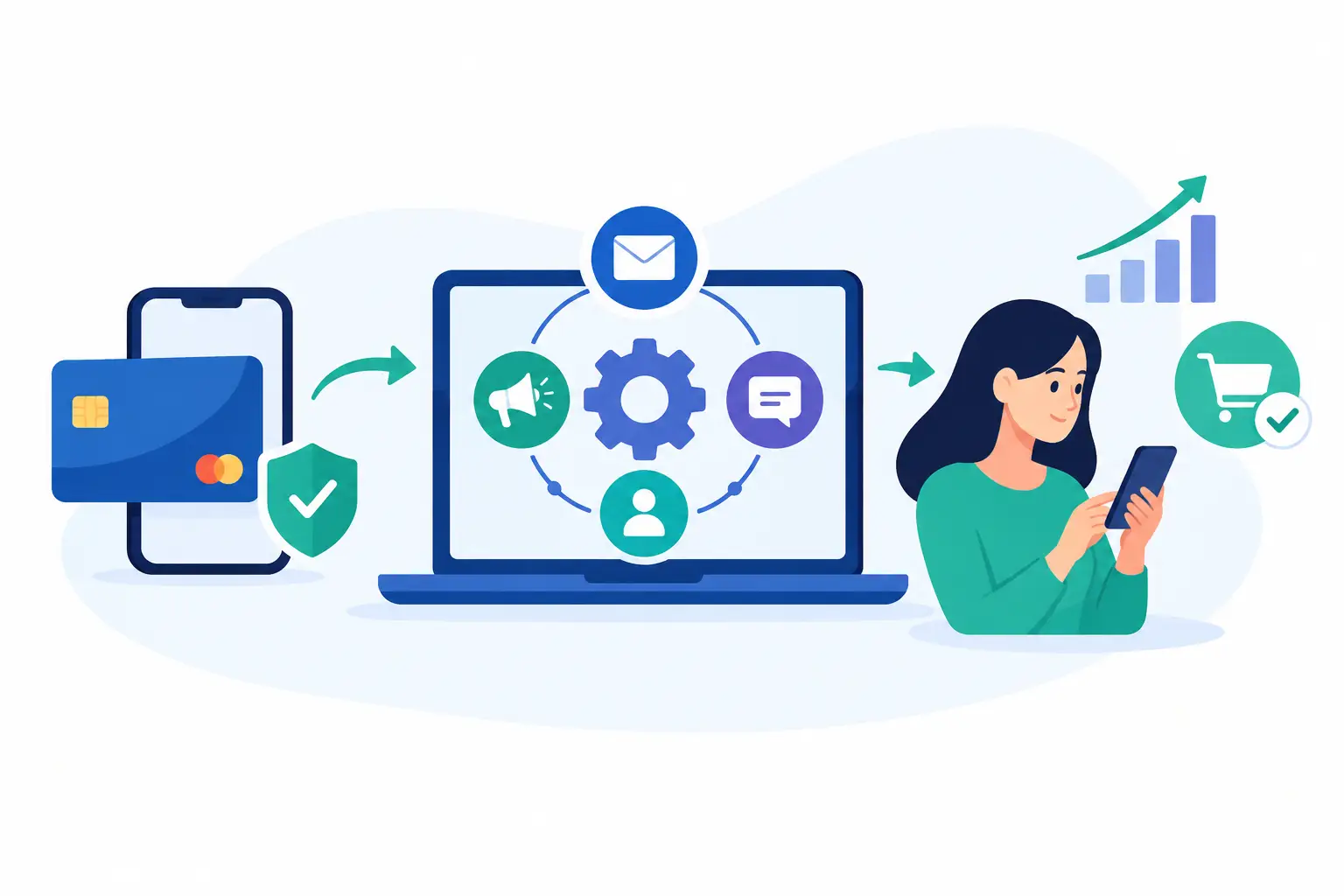
Integrated payments marketing automation connects the transaction to the follow-up. A completed purchase can update a customer profile and launch a post-purchase sequence. A failed payment can trigger a secure reminder. A high-value order can move a customer into a VIP segment. A repeat visit can add loyalty points and start a campaign designed to earn the next visit.
The goal is not to send more messages. The goal is to send messages that have a reason to exist.
Build automation around payment moments
The strongest payment automations are specific. They reflect what happened, what the customer may need next, and what action creates value for both sides.
Turn completed purchases into repeat revenue
A completed transaction is the best time to begin retention work. For a firearm retailer, a customer who purchases a safe may be a strong fit for an accessory, maintenance, or training offer later. For an alcohol brand or beverage retailer, a purchase can inform a future seasonal recommendation or a loyalty incentive. For a home service company, a paid invoice can trigger a review request followed by a maintenance reminder at the right interval.
Timing matters. The first message may simply confirm the experience and thank the customer. A second message can request feedback once the product or service has had time to deliver value. A later message can introduce a related offer. This is more effective than blasting the same promotion to every contact because the sequence begins with a verified customer action.
Recover incomplete payments without chasing people manually
Payment links and invoices are useful only if they get paid. When a customer receives an estimate, deposit request, event balance, or service invoice and does not complete payment, automation can handle the first follow-up with speed and consistency.
A practical workflow starts with a polite reminder shortly after the payment request. If no action is taken, a second reminder can clarify the due date or make the payment path easier to find. Once payment is completed, the reminder flow stops automatically and the customer moves into the correct post-payment journey.
The trade-off is frequency. A reminder sequence that is too aggressive can damage trust, especially for high-consideration purchases or customers dealing with a genuine issue. Use clear timing, suppress paid accounts immediately, and give the message a helpful purpose.
Make loyalty feel earned, not random
Loyalty programs lose momentum when customers cannot see the connection between spending and rewards. Payment-connected automation makes that connection visible. A transaction can add points, update a tier, or trigger a message that explains how close the customer is to their next reward.
That creates a better reason to return. Instead of receiving a generic discount, the customer receives a timely nudge tied to progress they already made. Multi-location businesses can also use payment data to recognize a customer across locations, provided their systems and consent practices support that experience.
Ask for reviews at the moment of highest confidence
Review requests work best when they arrive after a real, completed experience, not as an afterthought in a quarterly campaign. A paid service, fulfilled order, completed appointment, or successful event check-in provides a clean trigger.
Keep the request direct and give customers enough time to form an opinion. For quick-service or retail visits, that window may be short. For installation, training, or higher-ticket products, it may take longer. Automation handles the timing, but your business still needs to choose the timing that matches the customer experience.
Use payment data to segment with intent
Transaction data becomes powerful when it shapes who receives what next. Purchase amount, purchase frequency, location, product category, payment status, and last purchase date can all inform smarter audience segments.
A customer who spent once six months ago should not receive the same message as a customer who has purchased three times in 30 days. A VIP customer may deserve early access. A lapsed customer may need a specific reason to come back. Someone with an unpaid invoice needs a payment reminder, not a promotional campaign.
This is where automation protects your marketing budget. Better segmentation reduces wasted sends and helps teams focus offers where they are most likely to produce revenue. It also makes performance easier to measure because you can compare results by purchase behavior rather than relying on broad campaign averages.
Compliance is part of the workflow, not a final checkbox
For regulated industries, speed only matters if the workflow is built correctly. Firearms, alcohol, and tobacco businesses need communication programs that respect carrier rules, consent requirements, and registration expectations. Payment data may sharpen the message, but it does not remove the need for compliant marketing practices.
That means maintaining clear opt-in records, honoring opt-outs immediately, and using the right channels for the business category. Firearms, alcohol, and tobacco brands can use carrier-compliant SMS programs when properly registered and consented. Vape, CBD, THC, and cannabis-adjacent brands should use Telegram and email rather than SMS or text messaging under carrier policies.
Channel selection also affects the automation design. The best workflow is not necessarily the one with the most touchpoints. It is the one that reaches the customer through a permitted, expected channel with a message that fits the transaction.
What to measure after launch
Automation should earn its place in the stack. Start with revenue tied to completed follow-up actions, recovered payments, repeat purchase rate, review volume, loyalty participation, and time saved by staff. Then look deeper at which segments respond, which offers pull customers back, and where customers fall out of the payment journey.
Do not judge a workflow only by open rates or clicks. Those metrics can be useful diagnostics, but the real question is whether the automation changed business results. Did invoices get paid faster? Did first-time buyers return? Did customers spend more often? Did your team stop spending hours on manual reminders?
OtterText helps growth-focused businesses connect direct communication, payment collection, customer data, and automated follow-up in one practical operating system. The advantage is not another dashboard. It is the ability to act on a customer’s payment behavior before the moment passes.
Every transaction tells you something. The businesses that grow faster are the ones built to respond with a useful next step.